In 1963, America stood unrivaled as the world’s leader in all things infrastructure. It was a nation of engineering marvels, with millions flocking to witness the products of publicly-funded infrastructure projects, such as the Golden Gate Bridge and the Hoover Dam. Six decades later, the year is 2025 and we’ve fallen seriously behind.
What’s New?
In the United States, not very much. “Why” is a question of a century’s worth of history.
Viewing the 20th century as a race for modern infrastructure — in which nations with more complex, expansive, and accessible infrastructure were coincidingly safer, wealthier, healthier, and developed — allows us to see exactly where and how the US fell behind.
Emerging from the New Deal era, during which President Roosevelt’s Public Works Administration produced much of the highway and aviation infrastructure the nation continues to depend on today, Washington was filled with a fiscal fervor for infrastructure, particularly for the then-infant technology of the highway.
Continuing into the era of the Eisenhower administration, the federal government initiated the most ambitious infrastructure investment in the nation’s history: the Interstate Highway System. A vast network of highways was constructed that still remains Americans’ primary mode of traversing between American cities — an act that ironically marked the beginning of how the American hare slumbered, and was passed by the tortoise.
Flash forward nearly a decade, and the year 1964 saw American politicians witness the opening of the Shinkansen, the world’s first bullet train or high-speed rail line in Japan, a nation whose infrastructure was systematically dismantled by American warplanes just 20 years prior. For the first time, America was behind, and lawmakers were met with a 60 year dilemma: innovate towards high-speed rail, or maintain the highway system, which accommodated the billion-dollar car industry. Despite the numerous infrastructure investment acts that would pass in the decades to follow, the lack of any high-speed rail in the year 2025 demonstrates that American lawmakers chose the latter.
When Innovation is Priceless
Whether it be our roads, bridges, or trains, American public infrastructure is the most worn and aged in the developed world. The US Army Corps of Engineers, the agency that constructed the marvels that are the Panama Canal and Washington Monument, reports that the average age of a US bridge is 44 years, and 57 for dams. This is because of the federal government’s reaction to the dawn of high-speed rail in 1964, and more specifically, its rationale.
The United States reacted to first falling behind with President Johnson’s 1965 High-Speed Ground Transportation Act. In his remarks on the act’s passing, President Johnson would say, “This High-Speed Ground Transportation Act of 1965 really gives us, for the first time in history, a coordinated program for improving the transportation system that we have today, and making it a better servant Of [sic] our people.” Yet the act never produced high-speed rail in the United States. The law’s provisions produced New York’s Metroliner in 1969, a promising but costly high-speed experiment that never expanded beyond the Northeast Corridor. Here lies the fate of America’s high-speed rail. Met with lower-than-expected ticket sales, the Metroliner quickly ran into the problem of funding that left it with frequent technical issues, delays, and degradings. Expectations of profit, even in the proximity of the car industry, cannot possibly rationalize investment in high-speed rail, as high-speed rail is not invested in for self-serving individual utility but for its contribution to the public good.
Congress has continued its status quo of band-aids to infrastructure of old, and reluctance if not outright refusal to invest in the kind of expansive, public, accessible infrastructure President Johnson had in mind. While Japan’s Shinkansen saw further expansion and Europe commenced construction of its high-speed Eurostar system, the U.S. doubled down on highways and aviation. A year after the opening of the Metroliner, Congress passed the 1970 Rail Passenger Service Act to create what we now know as Amtrak. However, the agency wasn’t tasked with crafting America’s new system of high-speed rail, but with preserving the existing suboptimal rail system which increased lost riders to cars and lost cargo to semi-trucks. With the federal government standing by automobiles and the Interstate Highway System — bearing the simple maintenance costs of road repavement, and the abundant profits of the automobile industry — high-speed rail and, truly, any major public transportation investment has never stood a chance.
The Bandaids
It would be fallacious to portray the United States as a nation wholly unconcerned with high-speed rail, modern infrastructure, and the public good. It is more correct to state that meaningful investments such as those in high-speed rail are not and have not ever been pursued legislatively in a way that makes weightful, material, earnest progress. Take the Infrastructure Investment and Jobs Act — portrayed as the “the largest investment in our nation’s infrastructure in a generation” by President Biden. The bill’s $500 billion in appropriations stipulated only $66 billion for passenger and freight rail, with only a fraction ultimately funding high-speed rail projects, compared to $110 billion for roads, bridges, and highways.
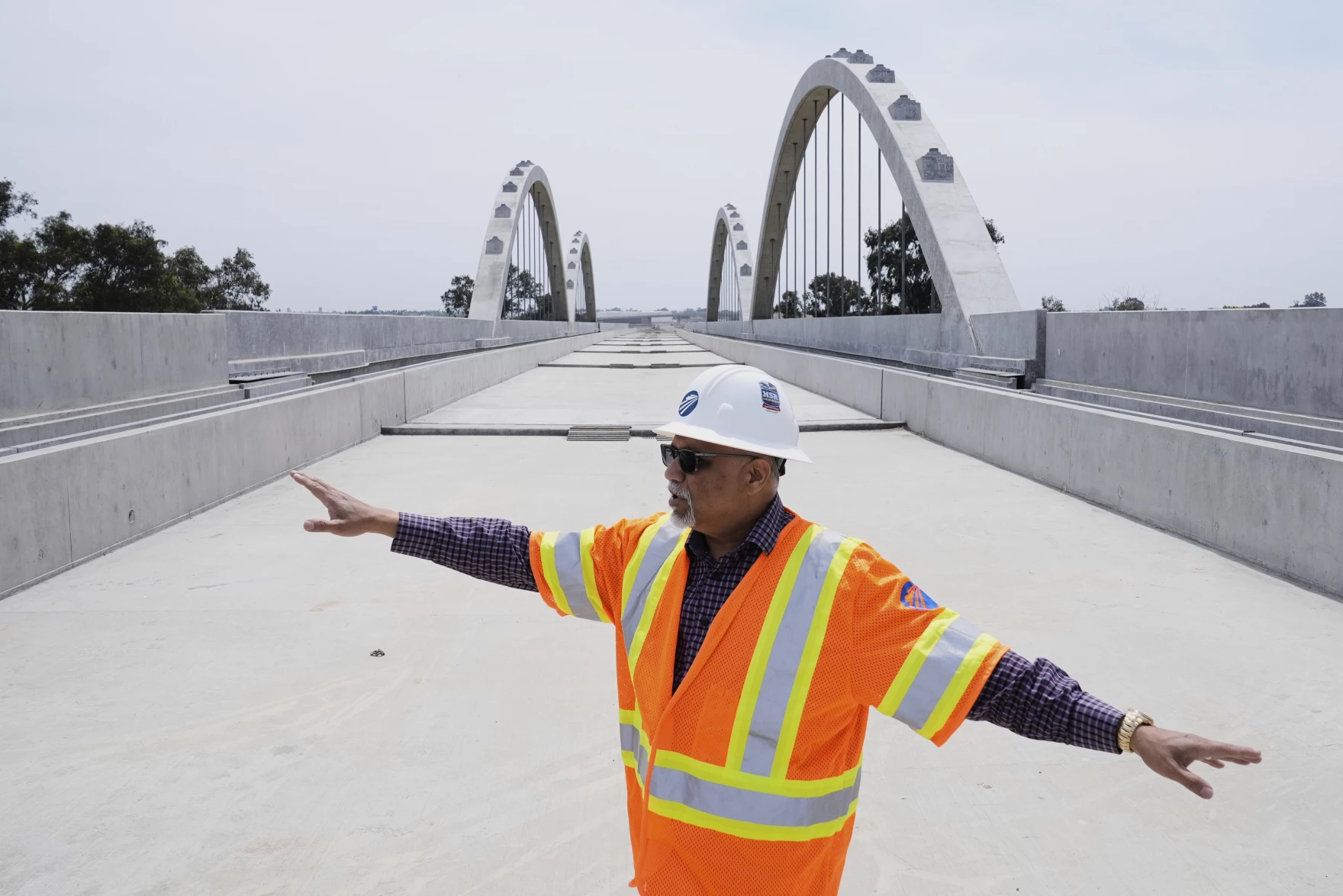
Even the projects federal investments have funded have been half-baked, mismanaged pursuits of high-speed rail. In 2008, California voters passed Proposition 1A, authorizing the construction of a high-speed rail line from Los Angeles to San Francisco with a nonstop ride time of under three hours. Since then, the project — which has yet to remotely approach completion — has seen budget overruns, delays, and little progress.
To put the situation into perspective, Japan’s Shinkansen, a much more well-planned and executed project, saw its 200 billion yen budget inflate to 380 billion yen by the completion of the first 320.2 mile segment. This is a 90% overrun compared to CHSR’s 200%. This has only been exacerbated by the fact that the state of California has taken on the brunt of the fiscal burden of the project; the federal government has been largely absent from what would be a national effort in any other nation, while highways received another $27 billion from the 2009 American Recovery and Reinvestment Act.
Are we still in the race?
The issue of high-speed rail is most damning in regards to the fundamental problems of the city: American cities are not getting more affordable, they are not expanding more employment opportunities to more people, and they’re not becoming places where young, working-class people can actually live. Rather, the political and fiscal rejection of high-speed rail perfectly encapsulates America’s stance against modernization and democratization. As America’s peers have pursued the public investments necessary to increase living standards and improve mobility in all senses, housing costs and unemployment rates in US cities have risen. Due to the lack of a cohesive high-speed rail system, those pushed out of gentrified areas lack the mobility to migrate to other regions. Only an increasingly dwindling fraction of any given American city’s population has the wealth to fund the car, fuel, and maintenance necessary to navigate America’s ubiquitous sprawling, low-density areas.
In quintessential American fashion, high-speed rail may have a future in the private realm. In 2023, the private Floridian inter-city rail operator Brightline announced its plans for a privately run, funded, and constructed high-speed rail line running from Los Angeles, California, to Las Vegas, Nevada. Initially funded by a combination of private bonds and loans, Brightline has since acquired $3 billion in federal grants through the Infrastructure Investment and Jobs Act, as well as $3.25 billion in bonds from the California Infrastructure and Economic Development Bank.
In glaring juxtaposition with America’s pattern of high-speed rail failures, Brightline West’s planned opening date of late 2028 seems not only feasible but likely. In fact, the privately-funded venture model of Brightline West may be the only chance America has of establishing an expansive system of high-speed rail at all. The sleeping American hare, long passed by the tortoise, may have very well been awoken by Brightline West’s unfortunate standard: high-speed rail running for profit. If such is the case, America may still be in the race for high-speed rail.
Featured Image Source: kpvr

