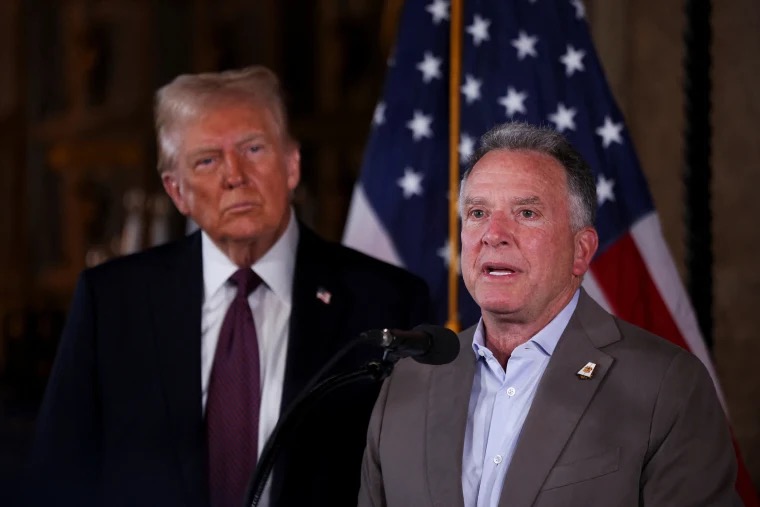
On October 13, President Donald Trump stood in front of the Knesset to give a speech following the U.S.-brokered ceasefire and hostage exchange deal in Gaza. In his remarks, he thanked just a handful of Americans who made the agreement possible, figures like Secretary of State Marco Rubio and Trump’s son-in-law, Jared Kushner. Before all of them, however, he thanked someone most Americans had never heard of: Steve Witkoff — an unlikely figure who played an indispensable role in the negotiations.
Who Is Steve Witkoff, and Why Him?
Before he was appointed President Trump’s special envoy to the Middle East, Steve Witkoff was virtually unknown outside of New York’s real estate world. He and Trump first met in the 1980s at a New York deli at 3 a.m., when Trump, short on cash, asked Witkoff to buy him a sandwich. This unexpected encounter marked the beginning of what would become 40 years of friendship.
Soft-spoken and private, Steve Witkoff is one of Trump’s most loyal allies. He stood by Trump after the January 6 riot, he was by his side during the second attempt on Trump’s life, and he named his grandson, Don James Witkoff, after the president. Susie Wiles, Trump’s White House chief of staff, says Witkoff is “first among equals” in Trump’s very small circle of true friends. This friendship earned him this role of envoy, and with it, a level of trust that could never be given to any other White House diplomat.
Witkoff had no experience in foreign policy, no diplomatic training, and no background in government. When asked what compelled him to step into diplomacy, his answer is simple: his son. Steve Witkoff lost his eldest son, Andrew, in 2011. Andrew was 22 years old when he died of a drug overdose. Now, Witkoff wears two Star of David necklaces in memory of those he’s lost — one that belonged to his father and one to his son.
“I do have this strong sensibility,” Witkoff told Atlantic reporter Isaac Stanley-Becker, “that my boy Andrew, who I lost, leads me to go do these things.” Pursuing peace throughout the world has become a way to work through his loss. “It’s a round trip for his healing of himself by doing something that’s not commercial,” said Thomas J. Barrack Jr., Trump’s longtime friend and U.S. ambassador to Turkey. Over time, Witkoff has built a close, almost familial relationship with the hostage families. He has given them a personal commitment that he will bring their sons and daughters home. Each time the mission falls short, he feels the weight of returning to friends with bad news, the kind of personal responsibility unique to a father. This role as envoy is far beyond professional duty; it has become a channel for his grief.
How He Made It All Work
Although Steve Witkoff has no formal experience in international diplomacy, he brings experience from high-stakes business deals in the Middle East, much like Jared Kushner. Both men have personal financial stakes in the Gulf through their own investments in countries like Qatar, Saudi Arabia, and the UAE.
One of Kushner and Witkoff’s greatest strengths is the fact that their roles are unofficial; they are essentially unpaid volunteers who “work in the background, and through [their] business interests, to bridge all of these sides.” But that also means they are not subject to the same guidelines that apply to government employees. Their business ties raise legitimate concerns. U.S. officials are expected to avoid private business dealings in countries where they conduct diplomacy, because it creates a tremendous conflict of interest. They could use their diplomatic relationships with Arab leaders to advance personal incentives, free from the safeguards intended to prevent conflicts of interest.
Yet the incentives go both ways: Kushner and Witkoff stand to gain financially from their private business ties in the region, while the Arab leaders see in them a rare opportunity to gain direct access to the Oval Office. Through these business relationships and diplomatic deals, they are positioned to reach the president not through embassies but through personal favor and private trust, which is a form of access that translates especially well in this administration.
Kushner has gained over $2 billion in commitments from Middle Eastern sovereign funds for his private equity firm six months after leaving the White House at the end of President Trump’s first term. Witkoff’s earlier ventures through the Witkoff Group involved partnerships with Gulf investors, particularly in Qatar. Many of these deals predate their diplomatic role in the government, but these entanglements inevitably create a dangerous temptation for U.S. envoys to prioritize their private interests over the nation’s foreign policy goals.
However, in this case, that very taboo became an asset when Kushner and Witkoff helped broker the Middle East ceasefire in October. In an interview with 60 Minutes, they defended what others called a conflict of interest, calling it “experience and trusted relationships.” The two diplomats explained that the deal wouldn’t have happened if not for the business relationship they had with the countries that helped to negotiate this deal. They understand that in the Middle East, business, political, and personal relationships are often intertwined.
This familiarity with Arab leaders also creates a tremendous margin for error when attempting to strike a peace deal. Kushner and Witkoff learned from the president during the negotiation process that Israel struck Qatar — a crucial peacemaker in this deal — in an effort to target Hamas leadership. This news left them feeling personally betrayed by Israeli leadership. It had made them, and the world, believe Israel had no intention of peace.
But what could have been a fatal error actually accelerated the peace process. In an effort to recover from this setback, President Trump forced Israeli Prime Minister Benjamin Netanyahu to apologize to the Qataris at the White House, in front of reporters. To the public, it seemed to bring Qatar back to the table, but behind the scenes, Qatar was only willing to speak with the Americans because its leaders had longstanding relationships with Kushner and Witkoff. Their nontraditional relationship with Qatari leaders earned America a second chance.
The strike also pushed the negotiations into unprecedented territory. For the first time, American diplomats sat down with Hamas. In traditional diplomacy, this is a hard red line. U.S. officials do not sit at the same table as a designated terrorist organization — but Witkoff and Kushner did. President Trump had given them the go-ahead to negotiate with Hamas directly. It is a decision that reflects both President Trump’s personal faith in them and his brand of pragmatism; as long as they were confident this talk would seal the deal, the president was willing to set aside protocol.
Once the Israelis, Arabs, and Americans were in the room together, what steered the direction of the talk was an unexpected human moment. One of the six people killed during the strike was the son of Khalil al-Hayya, Hamas’s top negotiator. In that room, he and Steve Witkoff found themselves face to face, not just as negotiators but as “members of a really bad club” — fathers who had buried their children. This shared grief didn’t make them allies, but it opened just enough space for the conversation to begin in earnest.
In places where his business expertise was no help, Witkoff offered them his whole heart. He entered the negotiating room not as a diplomat but as a grieving father who had buried his son. His genuine grief disarmed suspicion in a way diplomatic rhetoric could not. This ceasefire did not emerge from protocol or diplomatic orthodoxy; it emerged because someone was allowed to try something new and different.
What made this negotiation work was not a secret strategy hidden in a State Department handbook, but quite the opposite. Steve Witkoff entered the negotiations the way a businessman enters a deal: transactional and outcome-oriented. That language translated well in a region where power is personal and agreements are built on relationships. As Jared Kushner put it, “The experience that Steve and I have as deal guys is that you have to understand people.” Witkoff understands what the other side stands to gain, their intentions, and their concerns, and he uses that insight to move them toward an agreement.
This moment exposes a larger truth: America’s foreign policy may be too rigid for the conflicts it now faces. The chain of command, the caution, and the obsession with precedent are becoming liabilities. Unconventional diplomacy is not always the answer, but pretending it has no place in politics is a failure of imagination.
The Future of the Ceasefire
In May, Witkoff managed to pressure Hamas to release the last living American hostage in Gaza, Edan Alexander. Upon his return, Witkoff gave him the Star of David necklace that once belonged to his son. While the agreement was a striking achievement, this ceasefire deal demands the endurance of peace in the region.
While there are lingering doubts and deep skepticism surrounding the deal, the 20-point plan managed to deliver some immediate results that the former administration could not achieve: it ended active fighting, pushed the IDF back to a yellow line, provided humanitarian relief in Gaza, and returned all remaining living hostages. Phase one of the ceasefire brought relief; phase two will test whether it can survive. The next stage of negotiations is infinitely harder. It is expected to address the most volatile questions: Hamas disarmament, permanent security guarantees for Israel, and a governing structure for Gaza. And during this process, one spark in the region could resume fighting. But as phase two looms, Witkoff is already stepping into another conflict.
Looking Ahead
Immediately after securing phase one of the Middle East peace plan, Witkoff set off to talk with Russia about ending the war in Ukraine. Russian envoy Kirill Dmitriev said that there could be an end to the war in sight; he is scheduled to meet with Steve Witkoff on Saturday amid economic sanctions. Still, the outcome remains uncertain, and no promise of peace is assured.
But if Steve Witkoff has proven anything, it is that improbable outcomes become possible when he has the president’s trust to take risks others wouldn’t.
Witkoff reads people better than he reads policy; he knows that every negotiation begins with knowing who is sitting at the table. He and the president share the same instinct, and that is why the president trusts him to take chances others would not.
Witkoff has already delivered where seasoned diplomats could not. His methods are imperfect and unorthodox, but also undeniably effective. For now, he deserves at least the benefit of the doubt, and if he succeeds again, it will not be because he followed the script.
Featured Image Source: NBC News

