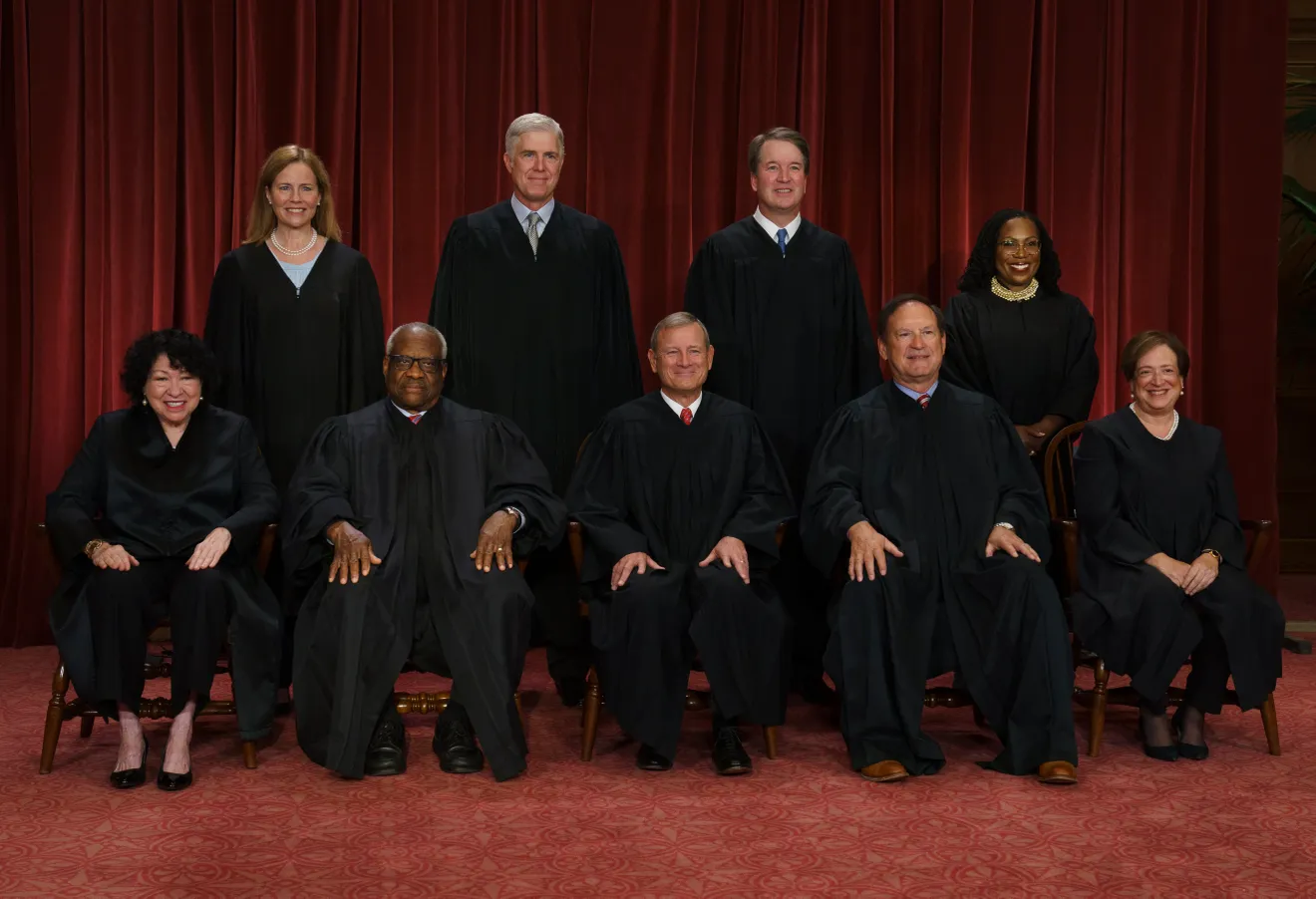
The Supreme Court’s recent decisions in favor of Trump’s policies have set off a wave of public anger and frustration. Many Democrats see a blatantly biased, Republican Court that has, and will continue to, bend the knee to Trump. While their outrage is justified, it is misdirected.
Rather than being affected by personal political affiliation, the Court has proven itself to be bound by a commitment to originalism, a legal theory that forces conservative and backwards outcomes. This is my target of concern, and it should be that of anyone who favors social progress. If originalism continues to dominate, the Court will become an impediment to the lives of a free people and modern governance.
In Trump’s second term, disagreement has generally revolved around unitary executive theory. An interpretation of the Constitution that argues that the President has virtually unlimited power when it comes to executive branch authority. Right now, Trump is using this theory as justification for a broad range of actions of questionable constitutionality. With three of the nine justices appointed by Trump himself, liberals worry about the six-to-three conservative majority advancing this theory to aid Trump in doing whatever he pleases, including firing federal workers and reallocating the federal budget.
I disagree with this premonition; a staunchly Trumpian Supreme Court is not the real danger of the moment. The expansion of presidential power actually comes from the judicial philosophy of the Court’s majority, not from the personal, conservative viewpoints of most of its members.
While conservatism and originalism are undeniably intertwined — because originalists are aware that this legal theory preserves traditional values — it is reductive to equate the two philosophies. Originalism is a constitutional theory that aims to interpret the Constitution through its meaning when it was ratified. This requires an understanding of the political landscape in periods often hundreds of years ago — an immensely difficult task — which brings forward the diversity within originalist thought.
Justice Clarence Thomas and former Justice Antonin Scalia’s disagreements over criminal law, specifically the interpretation of the word “unreasonable” in the 4th Amendment, emphasized that originalism can be applied uniquely to reach distinct conclusions without partisan or personal bias. To highlight the separation of originalism and conservatism, it’s worth pointing out that all of Trump’s appointees have joined opinions that blocked conservative goals.
Brett Kavanaugh sided with liberal justices in a racial gerrymandering case in 2023. In 2020, Neil Gorsuch voted to protect employees against discrimination based on gender or sexual orientation. Amy Coney Barrett, appointed by Trump to appease religious and pro-life Republicans, has emerged as a crucial and unpredictable centrist vote on the Court.
However, simply acknowledging that the Court’s decisions are dominated by one legal theory rather than by partisan bias does little to quell my fears about where it’s headed. The high-profile 2022 Dobbs decision, which overturned the right to an abortion granted by Roe v. Wade, was not the partisan overhaul it was made out to be — rather, it was a sinister display of how the current iteration of originalism has started to endanger civil liberties that we previously understood as undeniable.
Justice Samuel Alito, Dobbs’ author, wrote that abortion rights were not “deeply rooted in the Nation’s history and tradition” or “implicitly protected by any constitutional provision.” He further argued that when the Due Process Clause of the 14th Amendment was ratified, most states had laws that banned abortions at all stages. Therefore, the Due Process Clause was not intended to protect abortion rights, and Roe was a “weak and willful interpretation” otherwise.
The reasoning that Alito established in Dobbs demonstrates a radical era of originalist thought that does not account for the social, political, and technological advancements made since the beginning of the nation. This new brand of originalism is not radical in its interpretations, but in its scale: its daringness to take on and deny fundamental rights. As the dissenting opinion pointed out, Dobbs puts other civil rights at risk, like the right to contraception or gay marriage.
Originalism denies the Court’s ability to grant new rights and freedoms to the people. In direct contrast, historical pragmatic approaches have demonstrated how important judicial activism is to this country. When civil rights leaders initially failed to make progress through legislative and executive processes, they went to the courts to plead their case. In Brown v. Board of Education, which struck down racial segregation in public schools, the liberal Warren Court acknowledged the fact that it couldn’t determine whether the 14th Amendment had been intended to abolish segregation in public education. Therefore, they employed a different strategy:
In approaching this problem, we cannot turn the clock back to 1868, when the Amendment was adopted, or even to 1896, when Plessy v. Ferguson was written. We must consider public education in the light of its full development and its present place in American life throughout the Nation. Only in this way can it be determined if segregation in public schools deprives these plaintiffs of the equal protection of the laws.
— Brown v. Board of Education, 347 U.S. 483 (1954)
This ideology, called living constitutionalism, is held by the liberal minority on the Supreme Court and aims to interpret the Constitution to meet modern society’s needs.
If an originalist had approached this question, they likely would have been forced to find a determination in the intentions of the 14th Amendment. Whether an originalist would’ve reached the same conclusion as the Warren Court is uncertain, but it’s broadly irrelevant.
A 1995 paper by Professor Michael McConnell, a prominent originalist scholar, argues that certain immediately post-ratification congressional debates provide enough historical context for an originalist to vote “yes” on Brown. The Supreme Court never referenced these debates because the justices were not originalists and, therefore, did not need to use such justification to reach their conclusions. McConnell’s argumentation rests on the serendipitous discovery of debates whose equivalence likely could not be found to support future Equal Protection Clause-related decisions, like interracial and gay marriage rights. If our aim of examining Brown is to reflect on how originalism would have blocked necessary social change, then McConnell’s argument only emphasizes the haphazard and fortuitous nature of originalism and how it grants disproportionate power to the political landscapes of lucky two or three year blocks.
If the past shows us that originalism would have fallen short in multiple landmark cases, it makes no sense to continue to employ this method of interpretation in the future. In the same way that originalism would have neglected to serve Americans by disregarding important societal changes, the current originalist position serves Donald Trump by promoting the power of a unitary executive without accounting for how the executive branch has changed since the signing of the Constitution. The Founding Fathers never could have predicted the size of the federal bureaucracy or the extent of its responsibilities. Hence, only judicial pragmatism can effectively serve us today, in a time where virtually everything has changed since the founding.
So while the current Court scares me, it’s not because of some idea of unrelenting support for Trump and conservatism, but it’s because of faulty reasoning that puts civil liberties at risk. It can hardly be said that interracial marriage is “deeply rooted” in America’s history any more than abortions are — so what should we make of the right to an interracial marriage established in Loving v. Virginia?
Why should we prefer the political climate of the 1700s to the contemporary one? The extremes of originalism line up perfectly with the far-right: a nationwide return to the patriarchal, Protestant values of 1700s America.
At least political biases acknowledge and consider modern problems. Originalism attempts to take us out of the modern sphere entirely, a fatal flaw that extends past even civil rights. It risks creating a government that does not care to serve or govern modern institutions and modern people.
Featured Image Source: USA Today

