
“My biggest fear is seeing her one morning and not knowing if she’ll come back.”
This fear and daily uncertainty is a sentiment shared by the 5.8 million households in the United States that are home to at least one undocumented immigrant, amidst the second term of President Donald Trump. As of 2023, California had the largest “unauthorized” immigrant population in the country, numbering approximately 2.3 million immigrants without legal status.
These 2.3 million people live in constant fear as a direct result of the current administration’s goal, as articulated by Deputy Chief of Staff Stephen Miller, to “set a minimum of 3,000 arrests for ICE a day,” and the follow-through from masked ICE officers who freely grab unsuspecting individuals off the street.

ICE officers wearing masks to conceal their identity when conducting arrests, Source: Cato Institute
In the same interview, Miller asserts that “we can’t take the risk of letting these Biden illegals roam around freely so the next American daughter can get raped, the next American kid can get murdered, the next American family can get splintered and torn apart by people who came into this country unchecked…”
In reality, it’s the Trump administration’s immigration policy that is responsible for American families being “splintered and torn apart.” What Miller misses is the millions of U.S. citizens, born or naturalized, who live with and rely on undocumented parents and family members. Those are the families put in harm’s way by a policy claiming to target people who are violent criminals.
Most undocumented immigrants are not violent, nor are they criminals. And yet Stephen Miller and the Trump administration have promised the “largest deportation program of criminals in the history of America,” creating an inherent contradiction in their self-proclaimed policy–there aren’t enough undocumented immigrants who’ve committed crimes to meet their deportation promises. An exceptionally small portion of undocumented immigrants commit crimes, given that U.S.-born citizens are over two times more likely to be arrested for violent crimes than undocumented immigrants.

Felony offending rates based on a person’s immigration status, Source: PNAS
Therefore, ICE has turned to apprehending undocumented immigrants, legal permanent residents, and U.S. citizens alike, all in a desperate attempt to comply with the administration’s goal. For many, this has created an atmosphere of fear, prompting a shift in their daily lives.
Fear of ICE has caused a shift in predominantly immigrant communities across the state of California and the country. The targeting of undocumented farmworkers during raids on farming and rural communities in California prompted a 3.1 percent drop in the state’s overall workforce. A study conducted in the Central Valley, home to nearly one million immigrants, estimates that recent immigration raids have led to a 22 percent increase in daily student absences.
This is unsurprising, considering media coverage shows mothers being detained while dropping their kids off at school, ICE officials chasing unsuspecting farmworkers, and masked agents raiding Home Depots. Immigrants and their families are practically forced to shift their entire lives and routines, fearing their chance of being targeted by ICE.
I spoke with Elisa, who was born and raised in the Bay Area, and her mother, Mia, who is undocumented. Elisa expressed that “[recently] ICE has been near our community, [and] we’ve always been on alert. … I used to drive my mom to work because she was scared of just being pulled over and questioned. So I would take her to work, pick her up, and it’s like I had to pause my life.”

Protestors opposing ICE raids on a Southern California farm, Source: NPR
Not only have ICE officials become more aggressive, but the advertising from figures like Kristi Noem, Secretary of the Department of Homeland Security (DHS), has directly called on undocumented people to return to their countries, or risk severe “consequences.”
These “consequences” have unfolded throughout the last nine months of Trump’s second term. We have witnessed Venezuelan migrants being sent to a foreign mega-prison in El Salvador, and the creation of “Alligator Alcatraz,” an inhumane detention center for persons detained by ICE. This all occurs without constitutionally-guaranteed due process. Elisa told me that the deportation of ICE detainees to foreign countries creates additional uncertainty for her family. “She doesn’t know if she were to get deported where she would go.”

Kristi Noem at an ICE press conference; Source: Nashville Banner
Proponents of mass deportation fail to recognize what people who enter the U.S. without documents are being punished for: a desire to provide a better life for themselves and their families. “A lot of times in Mexico, we don’t have opportunities to have a steady job, and that’s the reason we try to look for a better life. If, for example, in Mexico, they had opportunities for us, we wouldn’t have to be here,” Mia told me.
The U.S. has also provided a much better opportunity for her kids than what would have been possible for them in Mexico. “[Elisa] has a lot of opportunities that in Mexico her cousins don’t have, and it can be for simple things, like a pair of shoes.”
Mia arrived here when she was just 17, crossing the border with her cousin’s two young children. “I applied for asylum, but, at that time, Mexico didn’t qualify, so they denied me.”
There’s a tendency to question undocumented people, to criticize choices made out of desperation and desire for the “American Dream.” For Mia to attain legal status, she would have to request voluntary departure and have it granted by a court. This would mean residing in Mexico for a specified time period before she could apply to legally re-enter the United States through the sponsorship of a family member.
So, why didn’t she?
“For me, what holds me [here] is my four kids. Because, I mean, when they were younger, who’s gonna take care of them?” Mia has four children who are U.S. citizens, born and raised in California. The extensive process of obtaining papers would have forced her into a challenging position, either leaving her young children behind for years or bringing them to a country they’re unaccustomed to. “If they go to Mexico, they will feel like [we do] here. They will feel like that’s strange for them… they [speak] Spanish, but it’s not a person who can completely live right away there.”
Immigrating to a new country at such a young age doesn’t come without sacrifice. “I haven’t been home for 34 years. …we [are] making money, but [we] also… lose a lot. Because I lost that many years [of] not seeing my parents.” Most immigrants don’t come to the United States to free-ride and take money from the government. It originates from a genuine need to improve their lives and the opportunities available to their families.
Trump’s second term introduced a greater extent of anxiety for Mia. This is the first time in her 34 years in this country that she has seen ICE conduct itself in such an aggressive manner and an administration leading on rhetoric that aims to dehumanize her and other undocumented immigrants. “If I go [to Mexico], the way that I apply to qualify, I would have to be there for three to ten years, and my husband [would have] to sponsor me… but with Trump right now, more like ten years.”
The Cato Institute considers legal immigration to the United States “nearly impossible,” considering that less than one percent of people who want to immigrate to this country legally are able to do so. Elisa tells me that “people who are just like ‘you should have done it another way, you should have come another way,’ they don’t understand how hard it is.”
The second Trump administration hasn’t just made the prospect of legal status in the United States more difficult for Mia. It developed new anxieties about the safety of her children in the only country they’ve ever truly known. “Any president has to [deport people], but… right now with Trump, they don’t let you prove yourself if you’re a U.S. citizen.”
“The fact that they’re born here, they don’t know any other countries. For me, I know where I come from. But Elisa, why should she have to pay for my decisions that I made… [my kids] should not even have to worry about what I did to get here.”
More than 170 U.S. Citizens have been detained by ICE since early 2025, likely a much higher number considering that DHS refuses to track the data of who ICE apprehends in their operations. The majority of the American citizens detained are Latino.
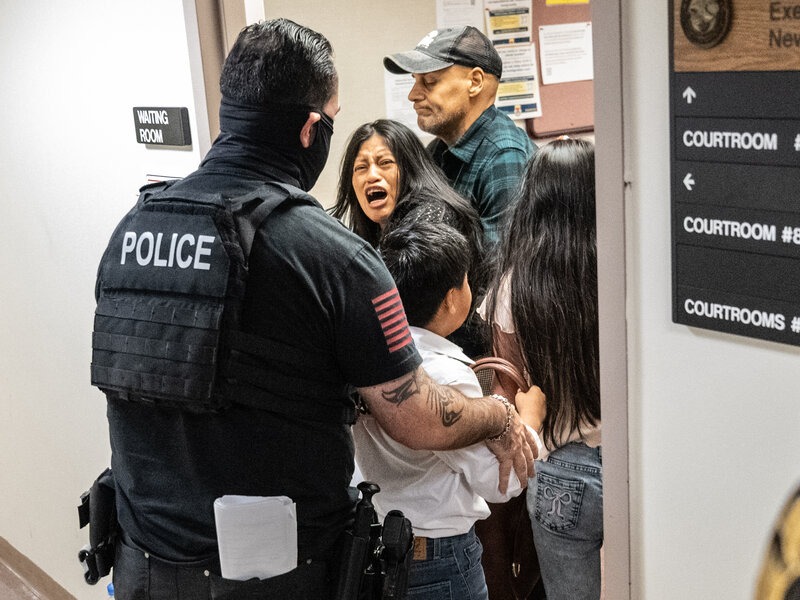
ICE officers initiating an altercation at a New York City immigration courthouse, Source: The New York Times
“I fear ICE profiling me… because I do appear very Mexican and I can’t really hide my appearance or take that away because that is me, ” Elisa confided.
The targeting of Latino Americans and her mom’s immigration status have significantly impacted the ability of Elisa and her family members to exercise their First Amendment rights and protest the actions of the U.S. government. “I personally don’t want to do something that will put my mom or anyone in danger and bring attention to the people [in my life] who are undocumented.”
In Noem v. Vasquez (2025), the Supreme Court sided with the DHS, essentially enabling the “profiling” of Latino Americans by ICE. The Los Angeles district court found that ICE and Border Patrol agents were stopping and detaining people solely on the basis of their race, the language they spoke, and working at certain places or particular jobs, a violation of the Fourth Amendment’s protections against unreasonable searches and seizures. However, the Supreme Court overturned the lower court’s decision, allowing the further targeting of Latinos based on ICE agents’ perceptions.
This raises concerning questions on whether or not the 14th Amendment’s “equal protection under the law” is actually being upheld by the current administration. Is it fair that Elisa, a U.S. citizen, is afraid to engage in acts of protest or attend traffic court, simply because she is Mexican and her mom is undocumented?
Actions by the current administration impact us all. Economically, California would lose an estimated $275 billion in both direct and ripple effects of losing the state’s undocumented immigrants. U.S. citizens and legal residents aren’t ensured that their rights will be protected if detained by immigration officials. Human beings fear for their safety on a daily basis, shying away from essential activities.
Elisa ended our conversation, asserting that “titling them as ‘aliens’ or ‘just criminals’ is very unfair to the people who actually are hardworking and who are actually here to bring themselves and their family out of [bad] situations they might be in where they originally came from… I grew up around a lot of undocumented people and I’m family with a lot of undocumented people, and what Trump and anyone that agrees with him [doesn’t] see is how hardworking they are.”
Author’s Note: Names have been changed to protect the identity of the individuals involved
Featured image source: Jonathan McIntosh via flickr (A metal mural on the Mexico side of the border with California. The mural is titled “Paseo de Humanidad,” meaning “Parade of Humanity,” depicting the struggles of immigrants on their way to the U.S.)